
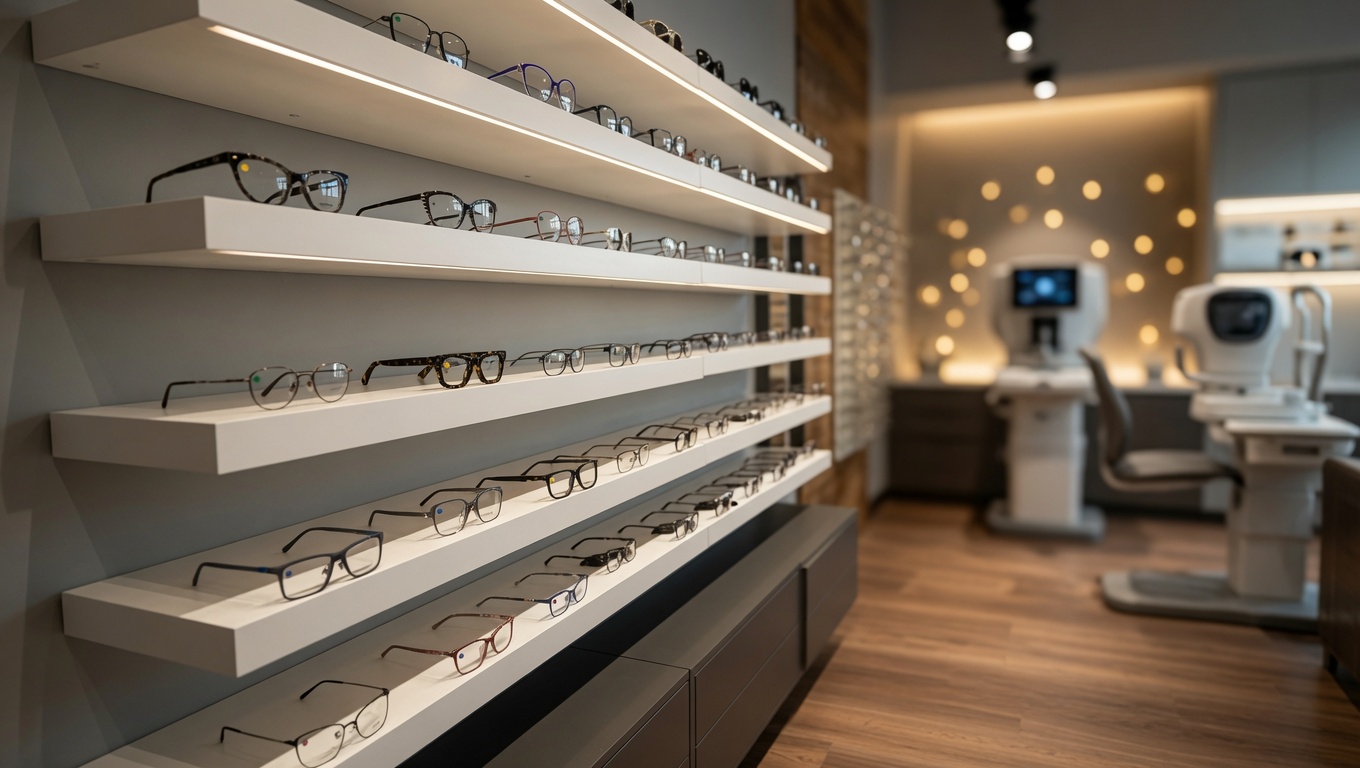
Eyewear & Frames in Pea Ridge
Frames should fit you — your face, your lifestyle, your prescription. We curate every frame in our showroom personally, so you're not lost in a wall of 500 lookalikes.
What sets our eyewear & frames apart.
Most retail optical stores carry rows of nearly-identical frames in every direction. Our optical is hand-curated — every frame on the wall earned its spot. You won't spend an hour sifting through duplicates; you'll spend that time finding the pair that's actually right.
Hand-curated frame selection
We choose each frame for fit quality, brand reputation, and lasting style — not just to fill the wall. Budget to designer, across face shapes, sizes, and material types.
Frame fitting expertise
A frame that fits properly prevents headaches, slipping, pressure points, and lens distortion. Our opticians adjust temple angle, nose pads, and bridge fit until your glasses sit right — and we adjust them again any time you bring them in.
Premium lens technology
Anti-reflective coatings, blue light filtering, photochromic (transitions), polarized sunwear, high-index for strong prescriptions, and digital-progressive designs. We explain the difference so you can choose what's worth the upgrade for you.
Insurance maximization
We work with most vision plans (VSP, EyeMed, Davis, Spectera, and more) and know how to combine frame allowances, lens benefits, and discounts so you get the most out of your coverage. We'll walk through the math before you commit.
Prescription sunwear & backup pairs
Most patients benefit from a dedicated sunglasses pair with prescription. We also fit second-pair backups for sports, computer use, or specific work tasks.
Standing adjustment & warranty service
Frames adjust over time as you wear them. Bring them in any time for a free adjustment. Manufacturer warranties on frame and lens defects are honored without a fight.

The lens choices that actually matter.
Most patients are told about lens upgrades at the checkout counter and asked to make decisions on the spot. Here's what's worth understanding before you arrive — and which upgrades are usually worth the money.
Anti-reflective (AR) coating
Reduces glare from screens, headlights, and overhead lighting. Almost always worth it — modern AR coatings also resist smudges and clean easily. The cheap AR coatings of 20 years ago that flaked off are gone; today's premium AR lasts years.
Blue light filtering
Filters a portion of the blue-violet wavelengths emitted by screens. Worth considering for patients who spend 6+ hours daily on devices, work night shifts, or experience screen-related eye fatigue or headaches. Cosmetically subtle — no yellow tint required.
Photochromic (transitions)
Lenses that darken in sunlight and clear indoors. Convenient for patients who don't want to swap between glasses and sunglasses. Worth the upgrade if you spend time outdoors but don't want a second pair. Modern versions activate faster and fade clearer than older generations.
Polarized prescription sunglasses
Eliminates glare from water, snow, and reflective surfaces — important for drivers, anglers, and anyone outdoors a lot. Polarized is the standard for true prescription sunwear; transitions are not a substitute for sunglasses while driving (they don't darken behind a windshield).
High-index lenses
For stronger prescriptions, high-index materials make lenses thinner and lighter. Worth it for any prescription stronger than about ±3.00 — improves cosmetics and comfort dramatically. The stronger your Rx, the more high-index matters.
Progressive lenses
For patients over 40 who need both distance and reading correction in one pair. Modern digital progressives are dramatically wider and clearer than the bifocals of past generations. We fit progressives to your specific frame, posture, and use case — not a one-size-fits-all template.
Your eyewear visit, step by step.
Walk into the showroom anytime during business hours — no appointment needed to browse, try on frames, or order glasses. Here's how a typical visit works.
Bring your prescription & insurance
Bring your current prescription (or have us pull it from your last exam), your vision insurance card or member ID, and any glasses you currently wear so we can match what's working and improve what isn't. Prescriptions are typically considered current for 1 to 2 years.
Browse & try on with an optician
Our optician helps narrow the wall based on your face shape, prescription type, and lifestyle. Most patients try on 6 to 10 frames and find the right pair in about 20 minutes. No pressure to buy on the spot — bring back a partner or come in twice if you need to.
Lens consultation & pricing
We walk through lens options (AR coating, blue light, photochromic, polarized, progressives) and explain which upgrades are worth it for your prescription and habits. Then we calculate insurance benefits and out-of-pocket cost together — no surprises.
Pickup & adjustment
Most prescriptions are ready in 7 to 10 business days. Complex prescriptions or specialty lens designs may take 2 to 3 weeks. When they arrive, we fit them to you in-office — temple angle, nose pads, bridge — and adjust again any time you bring them in. No appointment needed for adjustments.
Common questions about eyewear & frames
Do I need an exam to buy glasses here?+
No — bring in any valid current prescription and we can fit you with new glasses. We verify the prescription is current (typically within the last 1 to 2 years depending on your state and the issuing doctor). If your prescription has expired, we can schedule a comprehensive exam at the same visit.
How much do glasses cost?+
Cost depends on the frame you choose and the lens options. Frames in our showroom range from budget-friendly to designer. With most vision insurance, patients typically pay $50 to $250 out of pocket for a complete pair. Without insurance, complete glasses generally start around $150 to $200 for basic lenses in a budget frame. We walk through the math with you before you commit — no surprises at checkout.
What vision insurance plans do you accept?+
We accept most major vision plans including VSP, EyeMed, Davis Vision, Spectera, Superior Vision, NVA, and many others. We also accept FSA and HSA payment. Call (479) 208-6175 to verify your specific plan and we'll explain your frame and lens benefits before your visit.
Can I get prescription sunglasses?+
Yes. Most of our frames can be ordered as prescription sunglasses with polarized lenses, gradient tints, or solid tints. We also fit prescription wraparound sunglasses for sports. Polarized is the standard for sun protection and glare reduction — and it's worth knowing that photochromic (transitions) lenses don't darken behind a car windshield, so they're not a true sunglasses substitute for driving.
How long until my glasses are ready?+
Most standard prescriptions are ready for pickup in 7 to 10 business days. Complex prescriptions, high-index lenses, progressive designs, or specialty coatings may take 2 to 3 weeks. We'll give you an honest timeline at order, and we'll call you the moment they arrive.
What if my glasses don't feel right after pickup?+
Bring them back. Many adjustment issues are fit-related and we'll re-adjust temple angle, nose pads, or bridge fit on the spot. If there's a true prescription issue, we re-check the lenses against the order and remake them under our warranty. The first 30 days are the most common adjustment period — don't push through discomfort, just bring them in.
Do you carry frames for kids?+
Yes — we have a curated kids' frame selection sized for younger faces, including durable options for kids who are hard on glasses. Most plans cover children's frames and lenses at a higher benefit level than adults, and we know how to work that benefit. Pair with a pediatric eye exam for the full visit.
Can you adjust glasses I bought elsewhere?+
Yes, generally — we'll adjust frames you bought online or at another retailer for free during business hours, as a courtesy. Repairs on broken frames may have a small charge depending on the work needed and frame brand.
Stop by the showroom.
No appointment needed to browse, try on frames, or order new glasses. Walk in during business hours and an optician will help you find the right pair.
Let's see what good vision can do.
Book online in under a minute, or call us directly. New patients welcome.